


Justinian was one of the most influential emperors in Byzantine history. His reign, which lasted from 527 to 565 AD, profoundly transformed the Eastern Roman Empire, both on the legislative front and in military and cultural matters. His determination to restore the greatness of the ancient Roman Empire was reflected in a vast program of reconquests, in legal reform, and in the construction of architectural monuments that still survive today.
Justinian was born around 482 AD into a family of humble origins in the region of Dardania, an area of the Roman Empire that roughly extended between present-day Kosovo and part of North Macedonia. Raised at the court of Constantinople thanks to the support of his uncle Justin, who reigned as emperor starting in 518, he received an education and was introduced to the arts of government and diplomacy. Even in his youth, he displayed remarkable intelligence and skill, making him the ideal candidate for succession. Upon the death of Justin in 527, he was crowned emperor and set in motion a series of reforms aimed at transforming the structure of the Empire.
From the very beginning of his reign, great attention was paid to strengthening central authority. The most distant provinces were often governed by local officials acting independently, while frontier armies proved difficult to coordinate. To solve these problems, Justinian tasked a circle of trusted collaborators with reorganizing the administration and consolidating the authority of Constantinople over the entire imperial territory.
Among Justinian’s most enduring contributions were his major legislative reforms. The emperor created a commission led by Tribonian, an important Byzantine jurist and official. Drawing on reliable sources such as pre-existing Roman legal codes and the works of classical jurists, Tribonian compiled the Corpus Iuris Civilis. Published in multiple parts between 529 and 534, this work streamlined the laws and defined a coherent, uniform body of legislation. Thanks to this codification, a solid legal foundation was established for the Empire, which in turn influenced Western law in the centuries that followed.
The administrative apparatus also underwent a profound renewal. Justinian sought to eliminate corruption and ensure direct control over state finances. To achieve this, he reorganized the powers of local magistrates and strengthened the imperial courts, thereby limiting abuses of power and creating a more efficient administration. In addition, he imposed new taxes to fund both the military apparatus and the imposing building projects.
One of Justinian’s goals during his reign was to reconquer the territories that had once belonged to the Western Roman Empire. To achieve this aim, he relied on exceptionally talented generals, including Belisarius and Narses, who led military expeditions in North Africa, Italy, and part of the Iberian Peninsula. The campaign against the Vandals in Africa was swift and effective: they were defeated in 533, and the entire region returned to Byzantine rule.
The Gothic War, which began in 535, lasted longer and proved more grueling. The Ostrogoths, who had consolidated their power in Italy, offered fierce resistance. Nevertheless, Rome, Ravenna, and a large portion of the peninsula were eventually reunited with the eastern domains. The wars in the West took a very high toll in human and economic resources, leaving the Empire weakened by continuous military expenditures.
Justinian is often associated with a period of intense building activity, marking an age of splendor and prestige for both Constantinople and other cities of the Empire. Among the most famous works stands the Hagia Sophia, completed in 537, a masterpiece epitomizing the advances of Byzantine engineering and architecture. Designed by the architects Anthemius of Tralles and Isidore of Miletus, this basilica was conceived as a monument to the Christian faith and imperial power. Thanks to its majestic dome and interiors adorned with golden mosaics, Hagia Sophia was regarded for centuries as the most spectacular building in the Christian world.
Other churches, bridges, and fortifications were built or renovated by the emperor’s orders, thereby strengthening urban defenses and enhancing the prestige of the major Byzantine cities. In this way, the concept of an Empire uniting Roman tradition with Orthodox Christian faith under a single project took hold.
Despite his reformist drive and military successes, Justinian’s reign was not without serious crises. Between 541 and 542, the Empire was struck by a devastating plague—known as the Plague of Justinian—that spread rapidly and decimated the population, causing massive loss of life and a drastic collapse in agricultural and artisanal production. Religious tensions, tied to the theological controversies of the era, further eroded internal stability.
Before his death in 565, Justinian managed to maintain a semblance of control over the reconquered territories. Nevertheless, the Empire soon faced new waves of invading peoples—such as the Lombards in Italy—and had to contend with threats along its eastern borders, particularly from the Sasanian Persian Empire. Economic and demographic weakness left a difficult legacy for his successors, rendering precarious the fragile balance built over almost forty years of his reign.
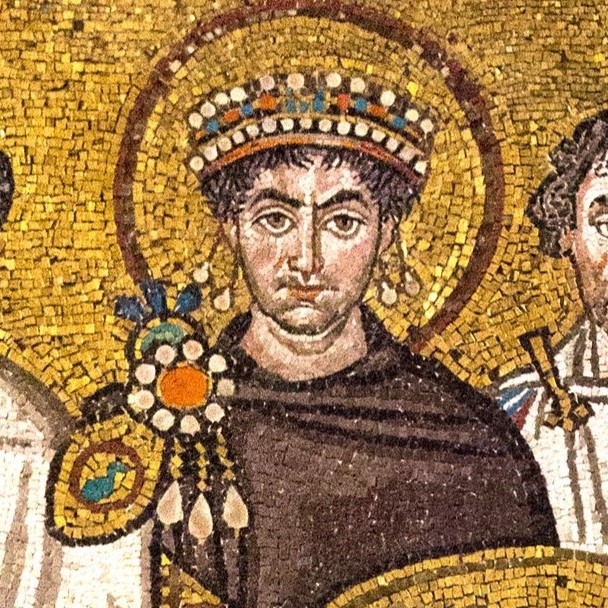
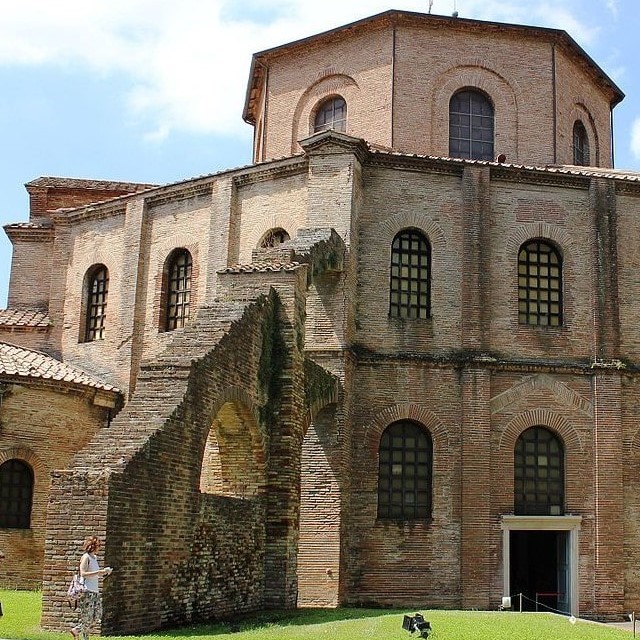
A striking example of Justinian’s artistic and cultural influence in the reconquered West can be found in Ravenna, the former capital of the Western Empire and later a major Byzantine center. Among the city’s most representative buildings is the Basilica of San Vitale, which houses one of the most celebrated mosaics of late antiquity: the depiction of Justinian surrounded by members of his court and Bishop Maximian.
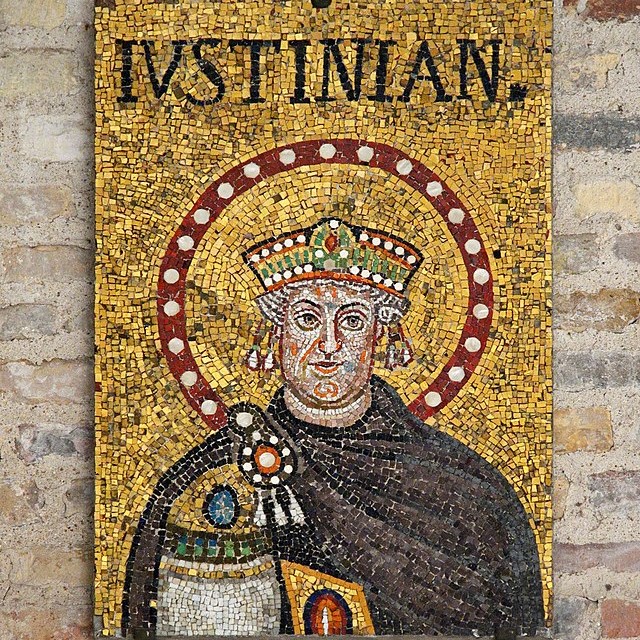
In this extraordinary composition, golden tesserae and vivid colors were used to accentuate Justinian’s sacred and imperial role. He is shown with a halo, symbolizing a power believed to derive from the divine. His gaze, fixed upon the viewer, underscores the notion of a monarch establishing an eternal bond with the faithful. At his side, civilian and religious dignitaries attest to the alliance between throne and altar, a cornerstone of Byzantine authority. This mosaic was not created merely for decorative purposes but also as a political and religious manifesto celebrating Orthodox Christian identity and Justinian’s legitimate role in the West.
Justinian, a complex and charismatic figure, strove to restore an Empire that reconciled its Roman roots with a new Christian reality. He advanced legal reforms that would shape the history of European law, embarked on military campaigns which, though fleeting, shifted the balance of power in the Mediterranean, and commissioned priceless monuments such as Hagia Sophia in Constantinople and the Basilica of San Vitale in Ravenna. Although his ambitions were not fully realized and the Empire did not long withstand external pressures, Justinian’s memory lives on, sustained by the grandeur of his works and the far-reaching impact of his reforms.
Immerse yourself in the enchantment of Ravenna’s mosaics and the stories that have shaped the city through a private tour led by a Ravenna tour guide. Admire the stunning Byzantine mosaics, the iconic portraits of Justinian and Theodora in the Basilica of San Vitale, and other UNESCO World Heritage monuments. Experience an unforgettable journey through art, history, and unique wonders found nowhere else in the world.
Please contact me to arrange your private tour of Ravenna.