


“The lion, they say, is recognized by its claws; similarly, those who read on will intuit the grandeur of the palace from its monumental gateway”.
With these words, Procopius of Caesarea, a Byzantine historian who lived during the reign of Emperor Justinian, introduces his description of the Chalké, the famous monumental portal that formed the main entrance to the imperial palace of Constantinople.
The grandeur and magnificence of imperial architecture were not exclusive to the Eastern capital. Historical sources tell us that in Ravenna, the ancient capital of the Gothic Kingdom under the rule of Theodoric, there was also a monumental entrance called Ad Chalchi, thus echoing the illustrious model of Constantinople in its name. But what did the entrance of Theodoric’s palace, which dominated the Ostrogothic kingdom for about thirty years between the end of the 5th and the beginning of the 6th century, actually look like?
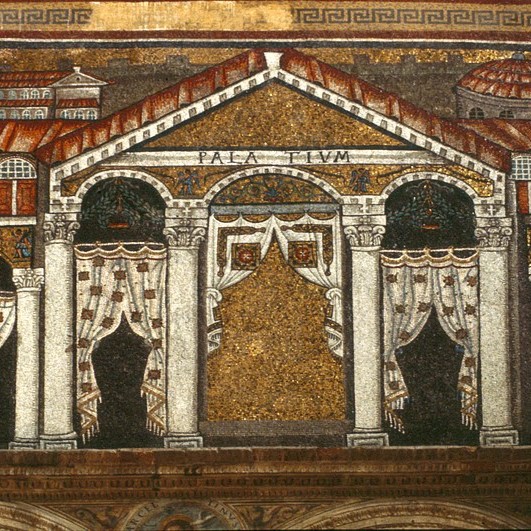
One of the most valuable testimonies we have at our disposal is found in Ravenna itself, inside the Basilica of Sant’Apollinare Nuovo, one of Ravenna’s eight UNESCO World Heritage monuments. The basilica, commissioned by the Gothic king himself as a palatine church, still preserves a mosaic representation of the Palatium, or royal palace. This mosaic, which presumably reproduced the features of Theodoric’s palace, was likely inspired by the architectural splendor of the imperial palace of Constantinople. However, the mosaic does not reach us in its original form, as it was reworked in the second half of the 6th century after the Byzantine reconquest of Ravenna. During that period, the Arian faith, professed by the Goths and to which the basilica was originally dedicated, was banned, and with it, many elements referencing Gothic culture were erased. The Basilica of Sant’Apollinare Nuovo, like other sacred buildings, underwent a process of reconversion, and the mosaics that adorned the central nave were partially modified, including the one depicting the Palatium.
Originally, between the palace’s columns, there were figures, likely statues, which were later replaced by curtains in the Sant’Apollinare Nuovo mosaic. Today, only traces of these figures remain: some hands, visible on the columns, which do not match the current design. Above the curtains, in the arches, there are also marks or halos that seem to correspond to laurel wreaths, decorative elements that in the original mosaic hung from the arches and can still be seen on either side of the palace entrance.
But the most intriguing element lies at the center of the composition. Here, among the golden tesserae of the door, a mysterious shape seems to emerge. It has been hypothesized that this spot originally depicted an equestrian statue of Theodoric, which, according to sources, decorated the entrance of his palace. It is believed that this statue was brought to Ravenna from Constantinople and that later, in the year 801, Charlemagne had it transferred to his residence in Aachen. From that moment on, however, the statue’s whereabouts became unknown, and no further trace of it has ever been found.
Thus, through fragments of history and mosaic tiles, the profile of Theodoric’s palace is reconstructed—an edifice that, in both name and appearance, sought to echo the grandeur of the Eastern capital, bearing witness to the cultural and architectural ties that linked Ravenna to Constantinople.
If you’d like to discover all of this with a passionate and knowledgeable guide, I invite you to explore Ravenna in my company. As a tour guide, I would be delighted to accompany you on a journey through the hidden treasures and great masterpieces of this remarkable city.
Please contact me to arrange your tour of Ravenna.